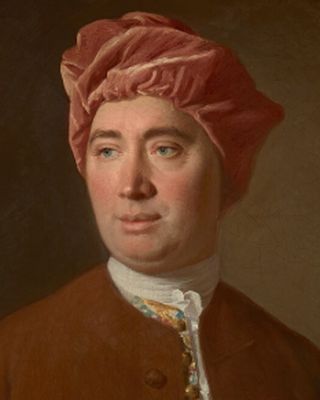
David Hume
1711–1776 · Scottish philosopher and historian
“Reason is the slave of the passions; the self is a bundle of perceptions”
Life and education
- Born
- 7 May 1711 (New Style), Edinburgh, Scotland
- Died
- 25 August 1776, Edinburgh
- Education
- University of Edinburgh (no degree)
- Career
- Keeper of the Advocates' Library, Edinburgh; secretary at the British embassy in Paris, and more
Philosopher and historian of the Scottish Enlightenment. The Treatise of Human Nature, written in his twenties, got almost no attention when it came out, but it's now seen as one of the most important philosophy books ever written in English. His religious skepticism cost him professorships at Edinburgh and Glasgow.
In his lifetime he was more famous as the author of The History of England. His skepticism and naturalism about causation, the self and morality woke Kant from his "dogmatic slumber" and still shape analytic philosophy and cognitive science today.
Timeline
- 1739–40A Treatise of Human Nature
- 1748An Enquiry Concerning Human Understanding — "Of Liberty and Necessity"
- 1751An Enquiry Concerning the Principles of Morals
- 1754–62The History of England
- 1779Dialogues Concerning Natural Religion (posthumous)
Big ideas
If you think like them…
If you're like Hume, you're suspicious of grand metaphysics and trust experience and feeling. You see morality as coming from human sympathy and sentiment rather than commands of reason, and you feel the "real me" is a looser flow than people think.
Rough positions on the five questions the quiz uses. These simplify each philosopher's actual views and are open to interpretation.
Thought experiments featuring them
Key works
- A Treatise of Human Nature (1739–40)
- An Enquiry Concerning Human Understanding (1748)
- An Enquiry Concerning the Principles of Morals (1751)
- Dialogues Concerning Natural Religion (1779)