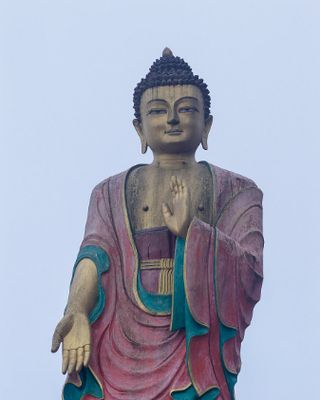
The Buddha (Siddhārtha Gautama)
c. 5th century BC · founder of Buddhism
“There is no unchanging self”
Life and education
- Born
- c. 5th century BC (dates debated), Lumbinī (now Nepal)
- Died
- Around age 80, Kuśinagara (now India)
- Practice
- Awakening at Bodh Gaya after about six years of ascetic practice
- Teaching
- First sermon at Sarnath, then about 45 years teaching across northern India
Founder of Buddhism, traditionally said to have been born a prince of the Śākya clan. Confronted with the suffering of old age, sickness and death, he left home, practiced, and reached awakening — becoming "the Buddha," the Awakened One. His dates were traditionally put in the 6th century BC, but many scholars now place him around the 5th century BC.
His teachings were passed down orally by disciples and later compiled into scriptures. The Four Noble Truths about suffering and its end, dependent origination (everything arises from conditions), and anattā — no unchanging self — are often compared with Western debates on personal identity today.
Timeline
- Before leaving homeGrows up as a Śākya prince
- Around 29Leaves home
- Around 35Awakening under the Bodhi tree at Bodh Gaya
- AfterFirst sermon at Sarnath; the community forms
- Around 80Passes away (parinirvāṇa) at Kuśinagara
Big ideas
If you think like them…
If you're like the Buddha, you hold the idea of a fixed "me" loosely. You see people and minds as constantly changing processes and find calm in understanding causes and conditions. You tend to believe morality is real insight into the path that reduces suffering.
Rough positions on the five questions the quiz uses. These simplify each philosopher's actual views and are open to interpretation.
Thought experiments featuring them
Key works
- Anattalakkhaṇa Sutta (Pāli Canon)
- Dhammacakkappavattana Sutta
- Dhammapada
- (Later text) the chariot simile in the Milindapañha