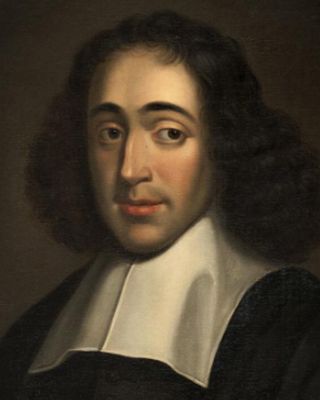
Baruch Spinoza
1632–1677 · Dutch philosopher
“Freedom is understanding necessity”
Life and education
- Born
- 24 November 1632, Amsterdam, Netherlands
- Died
- 21 February 1677, The Hague
- Education
- Amsterdam Jewish community school; then self-taught (Descartes, Latin)
- Fields
- Metaphysics, ethics, political philosophy, biblical criticism
Dutch philosopher born into a Portuguese-Jewish family. In 1656 he was excommunicated from Amsterdam's Jewish community for heretical views, and he went on to live simply, grinding lenses and devoting himself to philosophy. In 1673 he turned down a professorship at Heidelberg to protect his freedom of thought.
His masterpiece, the Ethics, is built like Euclid's geometry — definitions, axioms, propositions — and was published after his death. His view of God and Nature as one substance was long condemned as atheism, but went on to shape German idealism and the modern scientific worldview.
Timeline
- 1656Excommunicated from the Amsterdam Jewish community
- 1663Principles of Cartesian Philosophy
- 1670Theological-Political Treatise (anonymous)
- 1673Declines a Heidelberg chair
- 1677Dies; the Ethics and other works published posthumously
Big ideas
If you think like them…
If you're like Spinoza, you see everything as linked in chains of cause and effect. Rather than sliding into nihilism, you look for calm and freedom in understanding that necessity. You tend to try to understand why people act the way they do rather than rushing to blame them.
Rough positions on the five questions the quiz uses. These simplify each philosopher's actual views and are open to interpretation.
Thought experiments featuring them
Key works
- Ethics (1677, posthumous)
- Theological-Political Treatise (1670)
- Treatise on the Emendation of the Intellect (posthumous)