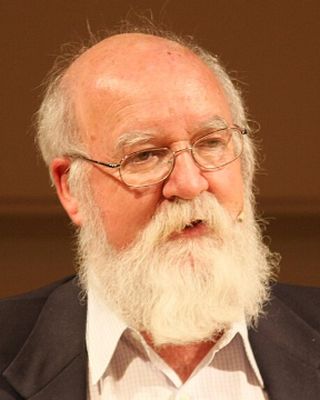
Daniel Dennett
1942–2024 · American philosopher and cognitive scientist
“Consciousness is the brain's user illusion”
Life and education
- Born
- 28 March 1942, Boston, USA
- Died
- 19 April 2024, Portland, Maine
- Education
- BA Harvard (1963); DPhil Oxford (1965, under Gilbert Ryle)
- Positions
- Tufts University from 1971; co-director of the Center for Cognitive Studies; later emeritus
American philosopher and cognitive scientist who tied questions about the mind, consciousness, free will and evolution tightly to science. He studied with ordinary-language philosopher Gilbert Ryle at Oxford and taught at Tufts for nearly half a century.
He argued consciousness is the product of many parallel brain processes, with no central "Cartesian theater" where it all comes together. On free will, he held that the freedom compatible with determinism is all the freedom worth wanting. As one of the "New Atheists," he also had a big public profile.
Timeline
- 1965DPhil, Oxford
- 1971Joins Tufts
- 1984Elbow Room — defending compatibilism
- 1991Consciousness Explained
- 1995Darwin's Dangerous Idea
- 2003Freedom Evolves
- 2024Dies 19 April
Big ideas
If you think like them…
If you're like Dennett, you trust the scientific picture of the world but don't give up on human freedom and responsibility. You'd rather treat consciousness as something explainable than leave it a mystery, and you're willing to question even gut intuitions about "what red feels like." You also lean toward thinking memory and personality carrying on is what makes you the same person.
Rough positions on the five questions the quiz uses. These simplify each philosopher's actual views and are open to interpretation.
Thought experiments featuring them
Key works
- Elbow Room (1984)
- Consciousness Explained (1991)
- Darwin's Dangerous Idea (1995)
- Freedom Evolves (2003)
- From Bacteria to Bach and Back (2017)