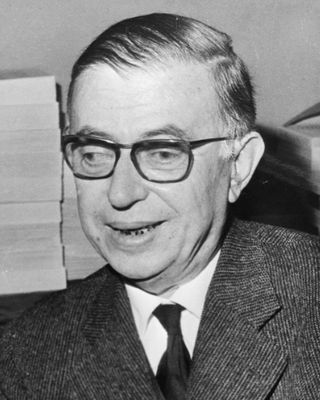
Jean-Paul Sartre
1905–1980 · French philosopher, novelist and playwright
“We are condemned to be free”
Life and education
- Born
- 21 June 1905, Paris, France
- Died
- 15 April 1980, Paris
- Education
- École Normale Supérieure; placed first in the 1929 agrégation in philosophy
- Fields
- Existentialism, phenomenology, political philosophy, literature
French philosopher, novelist and playwright, and the face of 20th-century existentialism. While teaching high school philosophy he studied Husserl's phenomenology in Berlin (1933–34) and built his own philosophy of consciousness and freedom on it.
With his lifelong partner Simone de Beauvoir he founded the journal Les Temps modernes and led postwar French intellectual life. He was awarded the 1964 Nobel Prize in Literature but turned it down, saying a writer shouldn't let himself be turned into an institution.
Timeline
- 1938Novel Nausea
- 1943Major work Being and Nothingness
- 1945Lecture "Existentialism Is a Humanism" (published 1946)
- 1960Critique of Dialectical Reason, vol. 1
- 1964Declines the Nobel Prize in Literature
Big ideas
If you think like them…
If you're like Sartre, you take moments of choice seriously. Instead of blaming your circumstances or nature, you tend to think "in the end, I picked this." You value meaning you give yourself over rules handed to you, and you lean toward seeing morality as something humans build rather than a fact written into the universe.
Rough positions on the five questions the quiz uses. These simplify each philosopher's actual views and are open to interpretation.
Thought experiments featuring them
Key works
- Being and Nothingness (1943)
- Existentialism Is a Humanism (1946)
- Nausea (1938)
- Critique of Dialectical Reason (1960)