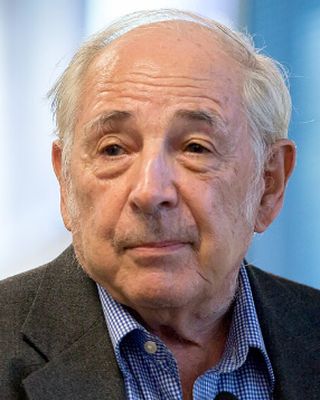
John Searle
1932–2025 · American philosopher
“Shuffling symbols isn't understanding”
Life and education
- Born
- 31 July 1932, Denver, Colorado, USA
- Died
- 17 September 2025, Safety Harbor, Florida (aged 93)
- Education
- University of Wisconsin; Oxford BA, MA and DPhil (Rhodes Scholar)
- Position
- UC Berkeley (1959; retired 2014, taught until 2016)
American philosopher who left a big mark on philosophy of language, philosophy of mind and social reality. At Oxford, influenced by J. L. Austin, he developed "speech act theory," which analyzes how saying things can be doing things.
His 1980 "Chinese Room" argument claimed that no program, however sophisticated, produces understanding or consciousness just by running — one of the most discussed arguments in the philosophy of AI. In 2019 Berkeley stripped his emeritus status for violating its sexual harassment policies. He died on 17 September 2025.
Timeline
- 1959Joins UC Berkeley; DPhil, Oxford
- 1969Speech Acts
- 1980"Minds, Brains, and Programs" — the Chinese Room
- 1983Intentionality
- 1992The Rediscovery of the Mind
- 1995The Construction of Social Reality
- 2025Dies 17 September
Big ideas
If you think like them…
If you're like Searle, you don't assume that acting the same means being the same inside. You think consciousness is real and comes from the brain — but that doesn't mean a computer can reproduce it by imitation. You have a middle-of-the-road streak that respects both common sense and science.
Rough positions on the five questions the quiz uses. These simplify each philosopher's actual views and are open to interpretation.
Thought experiments featuring them
Key works
- Speech Acts (1969)
- "Minds, Brains, and Programs" (1980)
- Intentionality (1983)
- The Rediscovery of the Mind (1992)
- The Construction of Social Reality (1995)