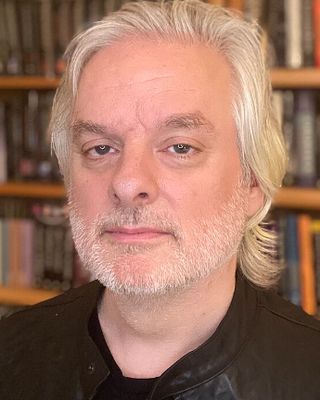
David Chalmers
b. 1966 · Australian philosopher
“Consciousness is still the "hard problem"”
Life and education
- Born
- 20 April 1966, Sydney, Australia
- Education
- BSc in mathematics, University of Adelaide (1986); Rhodes Scholar at Oxford; PhD in philosophy and cognitive science, Indiana University (1993, under Douglas Hofstadter)
- Position
- Professor of Philosophy and Neural Science, New York University; co-director of the Center for Mind, Brain and Consciousness
- Fields
- Consciousness, philosophy of mind, philosophy of language, philosophy of technology
Australian philosopher who coined the phrase "the hard problem of consciousness." After studying math, he earned his PhD under AI researcher Douglas Hofstadter, then worked at UC Santa Cruz, the University of Arizona (directing its Center for Consciousness Studies) and the Australian National University before settling at NYU.
In The Conscious Mind (1996) he mounted a systematic case that consciousness can't be explained by physical facts alone. He co-founded the PhilPapers database, and more recently has moved into virtual reality and AI consciousness with Reality+ (2022). In 2023 he won a 25-year bet, made in 1998 with neuroscientist Christof Koch, over whether the neural correlates of consciousness would be found.
Timeline
- 1993PhD, Indiana University
- 1995"Facing Up to the Problem of Consciousness" — the hard problem
- 1996The Conscious Mind
- 2010"The Singularity: A Philosophical Analysis"
- 2022Reality+: Virtual Worlds and the Problems of Philosophy
- 2023Wins his 25-year consciousness bet with Koch
Big ideas
If you think like them…
If you're like Chalmers, you respect science but won't brush aside the fact of "feeling." You think consciousness is tightly linked to brain activity but can't be fully explained by it. You're also open-minded about future questions like AI and mind uploading.
Rough positions on the five questions the quiz uses. These simplify each philosopher's actual views and are open to interpretation.
Thought experiments featuring them
Key works
- The Conscious Mind (1996)
- The Character of Consciousness (2010)
- Constructing the World (2012)
- Reality+ (2022)