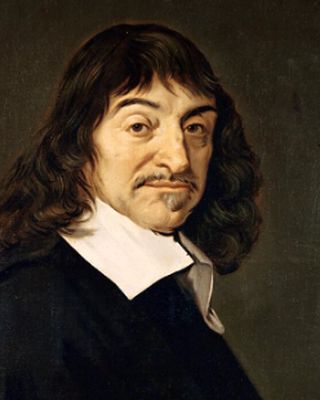
René Descartes
1596–1650 · French philosopher and mathematician
“I think, therefore I am”
Life and education
- Born
- 31 March 1596, La Haye (now Descartes), France
- Died
- 11 February 1650, Stockholm, Sweden
- Education
- Jesuit college of La Flèche; law degree, University of Poitiers (1616)
- Career
- Lived and wrote in the Netherlands for about 20 years from 1628
French philosopher and mathematician, often called the father of modern philosophy. He invented coordinate geometry, and to find a certain foundation for knowledge he tried "methodical doubt" — doubting everything that could be doubted.
That led him to "I think, therefore I am": whatever else I doubt, I can't doubt that I, the doubter, exist. His substance dualism — mind as thinking substance, body as extended substance — became the starting point of every later debate about mind and body. He died in Stockholm after Queen Christina of Sweden invited him there.
Timeline
- 1616Law degree, Poitiers
- 1628Moves to the Netherlands
- 1637Discourse on Method (with the Geometry)
- 1641Meditations on First Philosophy
- 1644Principles of Philosophy
- 1649The Passions of the Soul; leaves for Sweden
Big ideas
If you think like them…
If you're like Descartes, you feel consciousness can't be fully explained by matter. You believe your choices are truly yours and that the thinking "I" is the most certain thing there is. You like building your thinking step by step on solid foundations.
Rough positions on the five questions the quiz uses. These simplify each philosopher's actual views and are open to interpretation.
Thought experiments featuring them
Key works
- Discourse on Method (1637)
- Meditations on First Philosophy (1641)
- Principles of Philosophy (1644)
- The Passions of the Soul (1649)