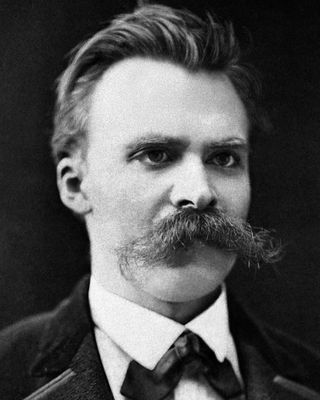
Friedrich Nietzsche
1844–1900 · German philosopher
“Create your own values”
Life and education
- Born
- 15 October 1844, Röcken, Saxony, Prussia
- Died
- 25 August 1900, Weimar, Germany
- Education
- Universities of Bonn and Leipzig (classical philology)
- Position
- Professor of Classical Philology, University of Basel (1869–1879)
German philosopher and a classical philology prodigy — appointed professor at Basel at 24, before he'd even finished his doctorate. Poor health made him give up the post in 1879, and he wrote most of his works while wandering around Europe.
He collapsed mentally in Turin in January 1889 and never recovered. He attacked Christian morality and Western metaphysics at the root, and his "genealogy" — digging into where values come from — hugely influenced existentialism, hermeneutics and postmodernism. After his death his sister distorted his ideas, and the Nazis exploited them.
Timeline
- 1869Appointed professor at Basel
- 1872The Birth of Tragedy
- 1882The Gay Science — "God is dead"
- 1883–85Thus Spoke Zarathustra
- 1886Beyond Good and Evil
- 1887On the Genealogy of Morality
- 1889Collapses in Turin
Big ideas
If you think like them…
If you're like Nietzsche, you don't just nod along to "that's how things should be." You ask where values came from and who they serve. You're suspicious of "free will" too — but instead of giving up, you go for creating your own values.
Rough positions on the five questions the quiz uses. These simplify each philosopher's actual views and are open to interpretation.
Thought experiments featuring them
Key works
- The Birth of Tragedy (1872)
- The Gay Science (1882)
- Thus Spoke Zarathustra (1883–85)
- Beyond Good and Evil (1886)
- On the Genealogy of Morality (1887)