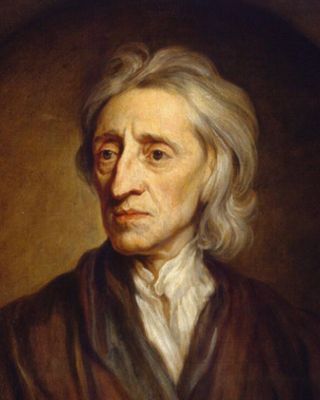
John Locke
1632–1704 · English philosopher and physician
“As long as memory carries on, you're the same person”
Life and education
- Born
- 29 August 1632, Wrington, Somerset, England
- Died
- 28 October 1704, Oates, Essex
- Education
- Westminster School; Christ Church, Oxford (studied medicine)
- Career
- Physician and secretary to the Earl of Shaftesbury; exile in the Netherlands (1683–1689)
English philosopher and physician who laid the foundations of empiricism and modern liberal political thought. As personal physician and adviser to the statesman Lord Shaftesbury he got deeply involved in politics, fled to the Netherlands during a political crisis, and came back after the Glorious Revolution.
His Essay Concerning Human Understanding, Two Treatises of Government and Letter Concerning Toleration all came out in 1689. He held that the mind starts as a "blank slate" and all ideas come from experience, and he's credited as the first philosopher to explain personal identity not by body or soul but by continuity of consciousness and memory.
Timeline
- 1652Enters Christ Church, Oxford
- 1667Joins the Shaftesbury household
- 1683Exile in the Netherlands
- 1689Essay Concerning Human Understanding (title page 1690), Two Treatises of Government, A Letter Concerning Toleration
- 16942nd edition of the Essay adds the chapter on personal identity
Big ideas
If you think like them…
If you're like Locke, you feel what makes "you" is the flow of memory and consciousness more than your body. In cases like teleportation or brain transplants, you think you go where your memories go. You also have a balanced streak that values experience and common sense.
Rough positions on the five questions the quiz uses. These simplify each philosopher's actual views and are open to interpretation.
Thought experiments featuring them
Key works
- An Essay Concerning Human Understanding (1689)
- Two Treatises of Government (1689)
- A Letter Concerning Toleration (1689)
- Some Thoughts Concerning Education (1693)