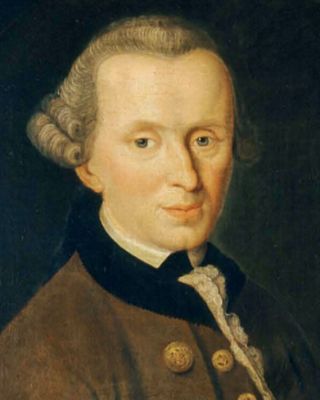
Immanuel Kant
1724–1804 · German philosopher
“Never treat people merely as a means”
Life and education
- Born
- 22 April 1724, Königsberg, Prussia (now Kaliningrad, Russia)
- Died
- 12 February 1804, Königsberg
- Education
- University of Königsberg
- Position
- Professor of Logic and Metaphysics, University of Königsberg (from 1770)
The towering German philosopher of the modern era, who barely ever left his hometown of Königsberg. After many years as an unsalaried lecturer he became a full professor at 46, and at 57 published the Critique of Pure Reason, launching his "critical philosophy."
In epistemology he pulled off a "Copernican revolution": the forms of the world we experience are shaped by our own cognitive faculties. In ethics he systematized deontology — act on principles you could universalize, not on expected outcomes. His plan for a league of nations for perpetual peace is an ideological root of today's international organizations.
Timeline
- 1770Becomes full professor at Königsberg
- 1781Critique of Pure Reason (2nd ed. 1787)
- 1785Groundwork of the Metaphysics of Morals
- 1788Critique of Practical Reason
- 1790Critique of Judgment
- 1795Perpetual Peace
- 1797Metaphysics of Morals; "On a Supposed Right to Lie from Philanthropy"
Big ideas
If you think like them…
If you're like Kant, you believe some lines must never be crossed, even for a good outcome. Using people as tools really bothers you, and you're strict about lying and breaking promises. You believe humans have a freedom and dignity that go beyond the laws of nature.
Rough positions on the five questions the quiz uses. These simplify each philosopher's actual views and are open to interpretation.
Thought experiments featuring them
Key works
- Critique of Pure Reason (1781)
- Groundwork of the Metaphysics of Morals (1785)
- Critique of Practical Reason (1788)
- Perpetual Peace (1795)