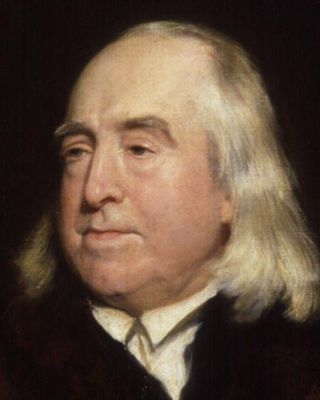
Jeremy Bentham
1748–1832 · English philosopher and legal reformer
“The greatest happiness of the greatest number”
Life and education
- Born
- 15 February 1748, London, England
- Died
- 6 June 1832, London
- Education
- Queen's College, Oxford (BA 1763); Lincoln's Inn
- Fields
- Ethics, philosophy of law, political and social reform
English philosopher and legal reformer, founder of modern utilitarianism. He entered Oxford at 12 and trained as a lawyer, but, fed up with how irrational English law was, spent his life on theory for reforming it.
He proposed judging actions and laws by the pleasure and pain they produce, and pushed reforms that were radical for his time — universal suffrage, banning cruelty to animals, decriminalizing homosexuality. He's also famous for designing the "Panopticon" prison. As he requested in his will, his preserved remains — the "Auto-Icon" — are still at University College London.
Timeline
- 1763Graduates from Oxford
- 1776A Fragment on Government
- 1789An Introduction to the Principles of Morals and Legislation (printed 1780)
- 1791Panopticon
- 1832Dies
Big ideas
If you think like them…
If you're like Bentham, you judge morality by how happy people actually are and how much they suffer, not by abstract principles. If a rule causes more misery, you think the rule should change. You're also a realist who sees the mind as what the brain and body do.
Rough positions on the five questions the quiz uses. These simplify each philosopher's actual views and are open to interpretation.
Thought experiments featuring them
Key works
- A Fragment on Government (1776)
- An Introduction to the Principles of Morals and Legislation (1789)
- Panopticon (1791)