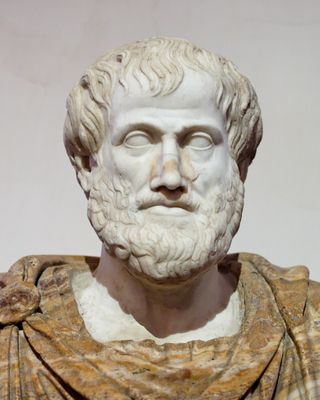
Aristotle
384–322 BC · Greek philosopher
“A good life is virtue in action, over a whole lifetime”
Life and education
- Born
- 384 BC, Stagira, near Macedonia
- Died
- 322 BC, Chalcis, Euboea
- Education
- Plato's Academy in Athens (about 20 years)
- Career
- Tutor to Alexander the Great; founded the Lyceum in Athens (c. 335 BC)
Ancient Greek philosopher who came to Athens around 17 and studied and taught at Plato's Academy for about 20 years, until Plato died. He then tutored the Macedonian prince Alexander, and later returned to Athens to found the Lyceum.
He laid the foundations of almost every field — logic, metaphysics, biology, ethics, politics, rhetoric, poetics. In ethics he saw happiness (eudaimonia) as activity in line with virtue, and taught that becoming a good person means building character through repeated practice.
Timeline
- c. 367 BCEnters Plato's Academy
- 347 BCLeaves Athens after Plato's death
- c. 343 BCBecomes Alexander's tutor
- c. 335 BCFounds the Lyceum in Athens
- 323 BCLeaves Athens amid anti-Macedonian sentiment after Alexander's death
Big ideas
If you think like them…
If you're like Aristotle, you value balance and judgment that fits the situation over rigid rules. You ask "what would a good person do?" and believe character can be shaped by habit. You also lean toward seeing people as living bodies before thinking souls.
Rough positions on the five questions the quiz uses. These simplify each philosopher's actual views and are open to interpretation.
Thought experiments featuring them
Key works
- Nicomachean Ethics
- Politics
- Metaphysics
- On the Soul (De Anima)
- Organon (logical works)