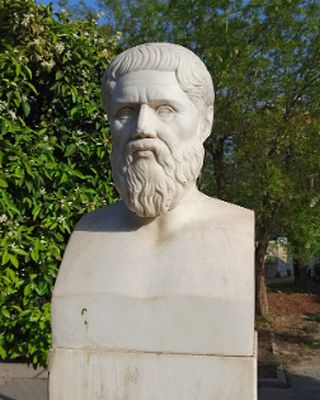
Plato
c. 428/427–348/347 BC · Greek philosopher
“The Good exists as an unchanging reality”
Life and education
- Born
- c. 428/427 BC, Athens
- Died
- c. 348/347 BC, Athens
- Teacher
- Socrates
- Career
- Founded the Academy in Athens (c. 387 BC)
Ancient Athenian philosopher, student of Socrates and teacher of Aristotle. Socrates' execution in 399 BC pushed him to wrestle with politics and justice for the rest of his life.
He wrote almost everything as dialogues starring Socrates. He held that beyond the changing world of the senses there are eternal, unchanging "Forms," topped by the Form of the Good. In the Phaedo he also argued that the soul is distinct from the body and survives death.
Timeline
- 399 BCTrial and death of Socrates (Apology)
- c. 387 BCFounds the Academy
- Middle periodPhaedo, Symposium, Republic
- Late periodTimaeus, Laws
Big ideas
If you think like them…
If you're like Plato, you believe right and wrong exist regardless of what people think. You look for the essence behind appearances, and you tend to feel the mind or soul can't be fully explained by the body.
Rough positions on the five questions the quiz uses. These simplify each philosopher's actual views and are open to interpretation.
Thought experiments featuring them
Key works
- Apology
- Phaedo
- Republic
- Symposium
- Timaeus