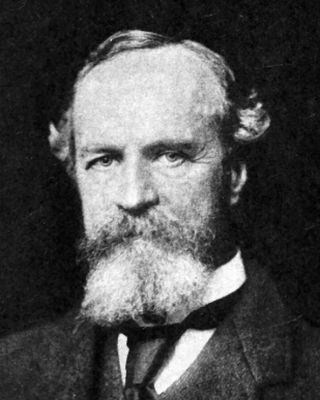
William James
1842–1910 · American philosopher and psychologist
“My first act of free will is to believe in free will”
Life and education
- Born
- 11 January 1842, New York City, USA
- Died
- 26 August 1910, Chocorua, New Hampshire
- Education
- Harvard, MD (1869)
- Position
- Harvard (1872–1907), professor of physiology, psychology and philosophy
American philosopher and psychologist who, with Peirce and Dewey, defined pragmatism. He was the older brother of novelist Henry James. After studying medicine and teaching physiology at Harvard, he moved into psychology and philosophy and set up one of America's first psychology labs.
As a young man he went through a deep depression; he's said to have pulled through after writing in his 1870 diary that "my first act of free will shall be to believe in free will." His Principles of Psychology popularized the phrase "stream of consciousness."
Timeline
- 1869MD, Harvard
- 1884Lecture "The Dilemma of Determinism"
- 1890The Principles of Psychology
- 1897The Will to Believe
- 1902The Varieties of Religious Experience
- 1907Pragmatism
Big ideas
If you think like them…
If you're like William James, you ask what difference an idea makes in real life before you care about grand theories. You approach questions like free will less through proof and more through "what kind of life does believing this create?" You feel that body, mind and the stream of memory all make up "you."
Rough positions on the five questions the quiz uses. These simplify each philosopher's actual views and are open to interpretation.
Thought experiments featuring them
Key works
- The Principles of Psychology (1890)
- The Will to Believe (1897)
- The Varieties of Religious Experience (1902)
- Pragmatism (1907)