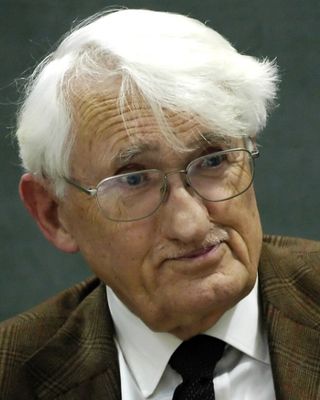
Jürgen Habermas
1929–2026 · German philosopher and social theorist
“Legitimacy comes from free and equal discussion”
Life and education
- Born
- 18 June 1929, Düsseldorf, Germany
- Died
- 14 March 2026 (aged 96)
- Education
- Göttingen, Zurich and Bonn; PhD, Bonn (1954)
- Positions
- Frankfurt Institute for Social Research (assistant to Adorno), Heidelberg, Frankfurt (1964–1971, 1983–1994), director of a Max Planck Institute (1971–1981)
German philosopher and social theorist, the leading figure of the Frankfurt School's second generation of critical theory. He started out as Theodor Adorno's assistant and made his name with The Structural Transformation of the Public Sphere (1962).
In his major work The Theory of Communicative Action (1981), he grounded reason in agreement reached through free and equal conversation, then extended that into theories of morality, law and democracy. Even after retiring he spoke out as a public intellectual on European integration, historical debates and biotechnology. He died on 14 March 2026, aged 96.
Timeline
- 1954PhD, Bonn (on Schelling)
- 1962The Structural Transformation of the Public Sphere
- 1968Knowledge and Human Interests
- 1981The Theory of Communicative Action
- 1983Moral Consciousness and Communicative Action — discourse ethics
- 1992Between Facts and Norms
- 2026Dies 14 March
Big ideas
If you think like them…
If you're like Habermas, you believe what's right comes from a fair conversation everyone takes part in, not from one person's gut or calculation. You see morality neither as mere feeling nor as transcendent fact, but as the product of rational agreement.
Rough positions on the five questions the quiz uses. These simplify each philosopher's actual views and are open to interpretation.
Thought experiments featuring them
Key works
- The Structural Transformation of the Public Sphere (1962)
- The Theory of Communicative Action (1981)
- Between Facts and Norms (1992)
- This Too a History of Philosophy (2019)